

The Fall of the House of Simcoe
- kmabel6
- Apr 11
- 14 min read
Updated: Apr 15
When Elizabeth Simcoe died in 1850, her grand plan of a family dynasty, rooted in the soil of East Devon, seemed assured. Her son, the Rev. Henry Addington Simcoe, had four living sons of his own to carry on the Simcoe name. His estate in Cornwall was thriving, and he was investing in that great, promising creature of the Industrial Revolution, the railway. Wolford Lodge itself had become the centre of a sizeable estate with its tenant farms, its valuable timber “plantation,” and its network of religious and social largesse. Whichever Simcoes presided at Wolford would, indeed, be lord and lady of the manor.

But it was not to be. A combination of bad timing and worse luck would lead to the downfall – and indeed, ultimate destruction – of her beloved home within just two generations. The story of the fall of the House of Simcoe is one that was being repeated across the nation.

On his death in 1806, John Graves Simcoe left the property in Devon to the eldest son (which was then Francis) with his widow holding a life interest. When she died forty-four years later, the property went to the eldest surviving (and now only) son, Henry. However, he did not move into Wolford Lodge because he had his own property in Cornwall. Instead, the five surviving daughters (Eliza, Caroline, Sophia, Katherine, and Ann) remained in the house for several years. In 1854, Ann (the youngest) married and moved to Herefordshire. The remaining sisters purchased an elegant townhouse on the magnificent Royal Crescent in Bath. They moved there at some point in the mid 1850s, taking with them sizeable personal fortunes and a goodly amount of furniture, which Elizabeth Simcoe had bequeathed to Eliza, the eldest.

Wolford was then offered for lease. The first tenants were John Mercer Bosville Durrant and his wife Frances (née Hubbard), a wealthy couple who floated from country house to country house and danced along the margins of the new aristocracy of the Industrial Revolution. Bosville Durrant was originally a London solicitor but as he inherited smallish properties in various places across southern England, he and Frances seem to have preferred to live in fine country homes in beautiful locations. They remained at Wolford Lodge for about a decade.
Elizabeth Simcoe might well have approved. Mrs. Durrant’s family included plenty of clergymen. Her brother (the 1st Baron Addington) had married into the Scottish establishment. Bosville Durrant once signed a petition against a plan to initiate postal services on Sundays; Mrs. Simcoe had theological reasons for her Sabbatarianism and his were expressed in more hard-nosed business arguments, but the underlying religious conviction was the same.

The Durrant offspring included two sons who had attended Winchester – perhaps not the Simcoe choice of Eton, but entirely respectable. The eldest son had joined the army and when his parents moved to Wolford, he was a newly minted captain with the 8th Hussars in the East India Company’s service. He would marry the daughter of a baronet soon after. The younger son was still at Winchester. In between them was another son who was just beginning his career in the Royal Navy; he would eventually become an admiral. Then there were four unmarried daughters who joined their parents at Wolford. It was very much a Simcoe social world.
While in residence, the Durrants contributed to local charities (including Mrs. Simcoe’s beloved church at Dunkeswell). Family events were duly noted in the same publications that had traced Simcoe lives: The Times, The Gentleman’s Magazine, and various of Burke’s and Kelly’s social handbooks. As had the Simcoes, the Durrants kept up appearances with an army of servants inside and out to care for their needs. They may have been simply tenants in the grand house, but they kept up the traditions of squireism very well indeed.

Meanwhile, Henry Addington Simcoe maintained a staff to manage the land, game, and tenantry. Joseph Burrows was known locally as Simcoe’s steward. He and his wife Hannah lived in Wolford Cottage as tenants of the Manor Farm with their youngest children (the eldest having moved on with their lives). Hannah was a local girl but Joseph was originally from Bath. They played an active part in the local agricultural community as had Simcoe stewards and managers in days gone by.
The 1861 census also captures a bailiff (John Reeves) and gamekeeper (Charles Steel and his wife Selina) living in “Woolford” House itself. The Durrants, like the Simcoes before them, seemed to favour occasional prolonged stays at the seaside.
All was not well between Joseph Burrows and Bosville Durrant, however. In the spring of 1859, Honiton was buzzing with the news that Durrant was taking Burrows to court, claiming that the latter was helping himself to grain “for his own consumption.” Local loyalties seem to have won out and the case was ultimately dismissed.
Perhaps Durrant tried to smooth things over, because in February 1861, the Devon and Exeter Gazette reported on “an excellent day’s sport” that had been enjoyed by the Reverend Simcoe’s tenants, courtesy of “B. Durrant, Esq.” Eleven rabbits lost their lives and a jolly dinner at Willey’s Royal Oak Inn wrapped up the day. Durrant was happy to assist as “the Squire of Wolford.”[1]
By the spring of 1864, the Durrants had resolved to move on and Wolford Lodge was once again advertised “to let” with possession available by Lady Day (March 25) in 1865. In February, the Durrants held a large auction of household goods, carriages, a 60-foot “glass orchard house” with producing fruit trees, and some unfortunate “sporting dogs.” They then packed up the rest and moved to Duddon Hall in the Lake District, a rather more modest house than Wolford but with the advantage of the nearby valley which had featured in some of William Wordsworth’s best-known sonnets.

Unfortunately for the Rev. Simcoe, this time there does not appear to have been much serious interest in Wolford Lodge. Advertisements continued to run in West Country newspapers with the conditions and offerings becoming more and more flexible as the months passed. It could be had partially furnished, with or without land, and keen sportsmen might have the fishing and “sporting” rights, should they wish it. The failure to find a lessee was the proverbial canary in the coalmine.
Just when the frustration and anxiety was mounting, a sad loss saved Wolford. Eliza Simcoe (eldest daughter and life-long helpmate to her mother) died at Bath on August 12, 1865. Among her many bequests was the magnificent sum of £30,000 that she directed be used for the upkeep at Wolford. And that enabled the family to arrange a highly satisfactory tenancy.
In 1861, Henry Addington Simcoe’s second son, John Kennaway Simcoe, had retired from a nineteen-year adventure with the Royal Navy. His older brother Henry had died in 1848, so John Simcoe was now the Simcoe heir presumptive. He lived at both Penheale (his father’s residence in Cornwall) and at the former Gwillim estate near Ross in Herefordshire that his father had inherited from Elizabeth Simcoe.

It was at the latter that he met and married Mary Jackson. Her father had recently retired from an army career and taken up residence with his wife and family at Glewstone Court, a few kilometers north of Old Court (the Gwillim-Simcoe property). The Simcoe newlyweds took a “wedding tour” on the continent then returned to live initially at Penheale with the remaining Simcoe clan.
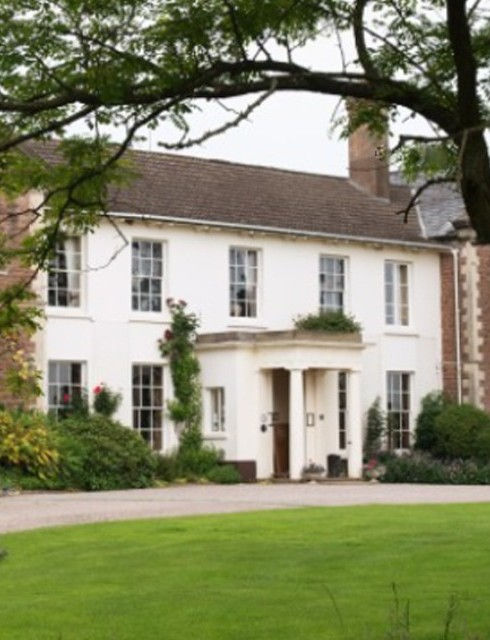

Soon, however, John Simcoe arranged with his father to rent Wolford Lodge, feasible now that Eliza’s money was helping. He and Mary moved in at some point late in 1867 or early 1868. “J.K.” (as he was always known in public) immediately took on his responsibilities as the future lord of the manor. He sat as a magistrate at Honiton and became an active patron of Elizabeth Simcoe’s church at Dunkeswell. He took an interest in the local agricultural society. His wife entertained frequently and generously.
Then on the 15th of November 1868, the Rev. Henry Addington Simcoe died. Wolford was now formally in the possession of Elizabeth Simcoe’s grandson.
For the next twenty-three years, Captain and Mrs. J.K. Simcoe lived very well indeed at Wolford. Clearly, they saw themselves as the original Simcoes had: local leaders in matters spiritual and temporal, both of which required putting on a grand show. They kept a large retinue of servants. They managed affairs at Holy Trinity, Dunkeswell. They dispensed largesse to worthy causes - including the Church Missionary Society, one of Elizabeth Simcoe’s favoured organizations. They renovated the family chapel, replacing the original wooden floor with tile and adding to its collection of carved wooden artifacts.
And John Simcoe was always known locally as “Captain” Simcoe, R.N., despite the fact that he had retired one rank below as a commander and was not officially authorized to use the rank of captain until 1876.

Their efforts to keep up the performance appear to have succeeded, for when Captain John died, the Devon and Exeter Gazette reported that “the Lodge” had been “occupied by the Simcoe family for centuries” (when it had been scarcely more than one).[2]
But there were troubling undertones. Although the Simcoes had the largest landholdings in the district, the income was essentially stagnant through the 1870s and 1880s. A major depression in England’s agricultural economy, coupled with a series of bad harvests, coincided with John Simcoe’s tenure as lord of the manor. Land taxes, rates payable under the New Poor Law, and ecclesiastical dues were all on the rise. Potential workers (domestic and agricultural) were leaving rural occupations in droves for better paying industrial jobs. Between 1871 and 1881, a royal commission estimated, the number of farm workers across the kingdom declined by some 92,000 (while there was an increase in the urban workforce of 53,000). John and Mary Simcoe do not seem to have realized that their lavish living and old-fashioned ideas about the landed gentry had become liabilities.

In March 1891, Captain Simcoe died childless. Mary lived on at Wolford Lodge, bringing in a 29-year-old niece to live with her as a companion. The position was undoubtedly much appreciated by the younger woman; she and a sister were being supported by their widowed father who had been a civil engineer in Burma but had been reduced to near penury in retirement.
Mary seemed determined to continue the old ways. The 1891 census captures a breathtaking staff at Wolford after John's death: a butler, page, coachman, and stable boy (the male coterie) with a housekeeper, laundress, cook, and two housemaids forming the female troops. A gamekeeper and his family occupied Wolford Cottage. Their salaries alone must have taken up the entire meager income from the tenants’ rents.
The Widow Simcoe continued to dispense largesse, although it must be admitted that the show was being made on a smaller and smaller scale. She hosted an annual “festival” for the Honiton Girls’ Friendly Society and attended local gatherings for worthy causes of various sorts.

But she also finally began to reduce the household staff, if only a little by little; in 1898 she reported that the estate income was “diminishing” noticeably and now brought in no more than £1000 a year (net).[3] When John Ross Robertson of Toronto visited Wolford during her tenure, he found it much reduced from the glory that he imagined it once had. He would later blame Mary Simcoe for not taking an interest in either its upkeep or Simcoe family history, but clearly, the middle-aged Mary was also caught in a very difficult situation.


Because Captain and Mrs. Simcoe had no children, the family decided that after her death, Wolford should go to the eldest living male descendant, Arthur Henry Linton, on the condition that he adopt the Simcoe surname. Arthur was a grandson of the Rev. H.A. Simcoe’s eldest daughter (Anne Eliza) and her husband (Sedley Bastard Marke). Their eldest daughter, Olivia Ann Marke, had married the Rev. George Linton, vicar of Corsham in Wiltshire, just outside Bath. Arthur Linton was thus a great-great-grandson of Elizabeth Simcoe’s.
At the time of his great-uncle’s death, Arthur was working as a junior bank clerk in Sherborne, Dorset. The unexpected news of his windfall was clearly life altering. Although he did not abandon his career in banking, he began to live on his great expectations, assisted by his great-aunt who provided him a small living of £30 per annum.
He seems to have believed he could live fast and high – and there seem to have been quite a few women willing to assist. At one point, he was injured in a serious accident of some sort and convinced a female family friend to give him £50 so he could go to the Canary Islands to recover. On the return trip, he wrote what we today would call an NSF cheque to an acquaintance who took exception to the deception. Arthur Henry Linton stood at the Old Bailey in June 1898 on charges of fraud. Mary Simcoe appeared as his defence’s first witness, testifying that the miscreant was heir to the estates at Wolford and Herefordshire (and so presumably had just made a mistake). Linton was found guilty but released on his own recognizance. He apparently went to live with his mother in Hammersmith. The banking career had come to a spectacular end.

Mary Simcoe died in October 1920; Arthur Henry Linton-Simcoe duly took possession of her estates. In December, he was warmly welcomed to Wolford by the tenantry and neighbours. However, the 1921 census records that he did not live in the big house but in nearby Victoria Cottage. Perhaps he had already realized that the upkeep of the Lodge was beyond him. As a single man, too, he had no women about who could assist.
Almost immediately, he began selling off parcels of things: pieces of land, standing timber, the household contents – starting, of course, with any objects that appeared to have some value as antiques. Linton-Simcoe does not seem to have been aware of the stories behind his household goods. And selling the land parcels turned out to be hard going. No-one else wanted to farm in East Devon any more, either.


If Linton-Simcoe did not care about the Simcoe legacy, the chief librarian of the Toronto Public Library certainly did. In 1922, he happened on a notice of an auction at Christie’s in London that referred to the Wolford estate. Dr. George H. Locke “took a chance” and wrote to “Mr. Simcoe” to enquire, not even knowing whether there was a Mr. Simcoe involved.

Arthur Linton-Simcoe wrote back, explaining that “owing to the high taxes because of the war,” he could not “keep up” the estate and was planning to sell everything. Locke was horrified and enquired further. Was he too late? Was anything left? And it was thus that a portrait of John Graves Simcoe as a young man with two friends, Simcoe’s two swords, and the colours of the Queen’s Rangers came to Toronto.[4] The painting was donated to the University of Toronto (where it remains) and the other objects became part of the Toronto Public Library’s collections. The fine art that Elizabeth Simcoe had inherited and cultivated was auctioned off, its original stories and provenance soon forgotten.


Wolford Lodge itself was purchased in 1923 or 1924 by Brigadier General Alick Gurdon Kemball, a career army officer who had served in India from the early 1890s to 1917. His last posting in the First World War had been as commandant of one of the brigades in the Egyptian Expeditionary Force under General Allenby (and better known, perhaps, for the exploits of another member, one T.E. Lawrence).

In 1924, Kemball and his wife Evelyn Mary (née Synge) tore down the Simcoe house and sold most of the demolition materials for scrap, although allegedly some doors were incorporated into a new, modern house that boasted of three “reception rooms,” six bedrooms, and some offices. John Ross Robertson dismissed it contemptuously as nothing in comparison to its predecessor.

The Kemballs did not enjoy their new house for long. In 1928, they advertised it for sale in Country Life magazine, praising its 144 acres of gardens, pastures, and woodlands. Canny salesmen this time noted the Canadian connection, hoping to enhance the value.

Eventually, the house was purchased by society newlyweds Alfred Gaspard Le Marchant and his Danish bride, Turdis Mortensen. A new chapter had begun.

Today, the building on the site is once again known as Wolford Lodge. It is a fixture on the Airbnb website where the entire house (with its “stunning” views toward the sea) can be had to any group that can afford it. Only the Simcoe chapel has been preserved and is now an historic site, owned and managed by the province of Ontario.[5]

But evil things, in robes of sorrow,
Assailed the monarch’s high estate;
(Ah, let us mourn, for never morrow
Shall dawn upon him, desolate!)
And, round about his home, the glory
That blushed and bloomed
Is but a dim-remembered story
Of the old time entombed.
From “The Haunted Palace” by Edgar Allan Poe, 1839
(with apologies to Poe for the blog title)
[1] Devon and Exeter Gazette, 22 February 1861, p. 5 (Dunkeswell news).
[2] Devon and Exeter Gazette, 28 March 1891, p. 5 (“Funeral of Captain Simcoe, R.N., J.P.”).
[3] In her testimony to an Old Bailey trial, 20 June 1898. The transcripts of these trials are available on-line at https://www.oldbaileyonline.org/
[4] George Locke recounted the story in an address to the Ontario Historical Society, printed in the 1923 report of their annual meeting, p. 11.
[5] See my essay “ ‘A Storage Place for Manure’ and the Politics of Commemoration,” University of Toronto Quarterly 92/4 (November 2023)” 661-684. I bear no responsibility for the citation method used!


Comments