

The Simcoe Legacy (1): Children
Elizabeth Simcoe left behind a large and growing family who seemed poised to carry on her campaigns. Although she had lost five of her eleven children (and her first grandson) by the time of her death, there remained six children: five daughters and son Henry, who had by now ten children of his own, with another on the way. But dramatic changes were brewing.

Industry was replacing agriculture as the basis of England’s economic strength; the landed gentry found it increasingly difficult to support themselves and the country estates were being sold off, one by one. New voting interests were shifting the balance of power in government. And the vagaries of personal lives conspired to turn the Simcoe family fortunes through a steady downward spiral. Not only was the public world that Elizabeth Simcoe had worked to sustain fading away, but so too was her private world.
On her death, the estate at Wolford passed to the sole surviving son, the Rev. Henry Addington Simcoe. However, Mrs. Simcoe left significant provisions for her five remaining daughters who were already well-to-do through legacies from a family that valued the financial independence of women. Eliza (now 66), Caroline (62), Sophia (60), Katherine (49), and Ann (46) remained at Wolford Lodge for several years while the complex affairs of the Simcoe legacies were sorted.
They faced three serious complications.
First, the bank at Honiton (with which the family had done business since its founding in 1786) had collapsed in 1847, apparently an early victim of declining revenues from country estates. Proprietors Flood and Lott attempted to restore the business but ultimately failed; court cases arising from the collapse went on for several years. Clearly, at least some Simcoe money was lost in the process.
Second, there was much juggling with lawyers over the Gwillim properties in Herefordshire. Elizabeth Simcoe had stipulated that her surviving daughters receive equal amounts in property and stocks from them, but the valuations and calculations proved complex and lengthy.
Third, an Oundle resident named Charles Paul Berkeley claimed that he was owed money in connection with one of the late William Walcot’s properties that had been passed on to the Simcoes. That matter, too, worked its way slowly through the courts until at least 1853.
In any case, 1854 marked the final year for the Simcoe sisters at Wolford Lodge.
The first to leave was Ann (the youngest). On the 12th of January, she ran off to London and married William Allford in an astonishing break with family and convention.[1] More on her adventure shortly.
Soon after, the four other sisters found a new home in Bath. Located at 33 Marlborough Buildings, they could admire the famous Royal Crescent from their front windows and large open fields from the rear. Late that year, Eliza held an auction at Wolford of the household and farm effects that she had inherited from her mother (as the eldest daughter).


Undoubtedly, the final break with their beloved Wolford was painful, but the move to Bath would bring considerable advantage. It was, of course, known to the Simcoe sisters from childhood and they could slip easily into circles of old friends. There were the literary and intellectual daughters of their mother’s generation, perhaps no longer called the Bath Bluestockings, but of a similar persuasion. There were charitable and religious causes, too. Besides the many single women who lived permanently in the city, there were the annual migrations of others from around the kingdom who enriched what might have otherwise been a somewhat insular society. Bath was no longer the destination of choice for the fashionable set, but then, it had never been fashion that had attracted Elizabeth Simcoe and her daughters there in the past.

Eliza, Caroline, Sophia, and Katherine remained together in the Marlborough terrace for a few years, then circa 1858, they moved across the street to that gem of Bath architecture, the Royal Crescent. They purchased No. 11, which had once belonged to celebrity musician (and manager of the Bath Assembly Rooms), Thomas Linley. His daughter, singer Elizabeth Ann Linley, had eloped from the house in 1772 with playwright and poet Richard Brinslay Sheridan – a moment that captured the public’s imagination. The house now sports an historic plaque for that reason.

The Simcoe sisters did not enjoy a long tenure together at No. 11, however. Caroline was the first to die (in 1858 at the age of 70). Next was the youngest, Katherine, who died at the age of 60 in 1861. Sophia followed her in 1864 (age 75). Eldest daughter Eliza outlived all her sisters, dying at the age of 81 in 1865. Each was laid to rest in turn at the private family chapel above Wolford Lodge in the tranquility of the East Devon countryside.

Even in death, the sisters ensured aspects of their mother’s legacy. Eliza bequeathed £30,000 for the upkeep of the Wolford estate and endowed several charities, including for the schools at Dunkeswell and Hemyock. Caroline left a personal estate of some £18,000 also put mostly to charitable effect. Katherine’s personal estate was similarly large (£18,800) and similarly distributed. Even the sermon preached at Eliza’s funeral was published in Exeter to raise funds for the church, just as had the sermon preached at her mother’s funeral fifteen years before.
The extraordinary story of daughter Ann merits some consideration. Many early sources claimed that she died in 1858, but that was hardly the case. Instead, she made a very unusual marriage and went off to live in rural Herefordshire.
Ann’s husband was William Allford (sometimes spelled Alford), the son of a Venn Ottery agricultural labourer and later tenant farmer named John Allford. William’s mother, Sarah (née Hillier) supplemented the large family’s income making lace.

At the time of her marriage, Ann Simcoe was in her 50th year; the groom was in his 33rd. In the marriage registry, his occupation is given as “servant.” And although he claimed to be a bachelor, he had been married before: in 1843 to a girl from Exeter. The 1851 census captured the couple living near Sidbury (Devon) where he was managing a farm. His first wife disappears from the documentary record in 1852/3, so presumably she had died a year or two before William married General Simcoe’s daughter. There do not appear to have been any children from this first marriage, and as Ann Simcoe was decidedly middle-aged, there would be none from his second, either. Instead, he was able to support a nephew (and namesake) in his own dramatic rise in the world.
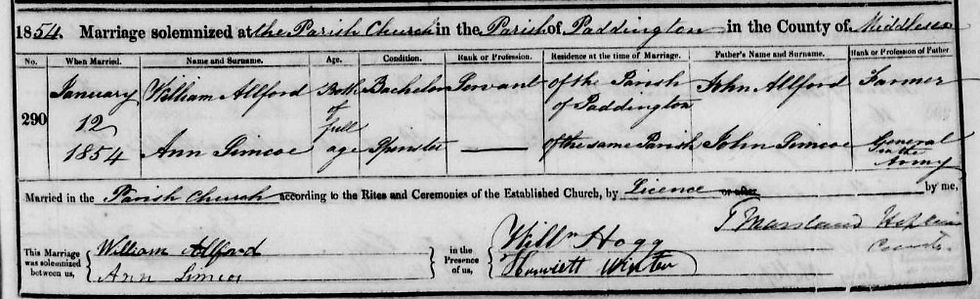
It appears that the rest of Ann’s family was taken by surprise with these developments and were kept somewhat in the dark, for the question of her possible marriage was raised by one of the lawyers trying to settle Elizabeth Simcoe’s estate. Matters would be put on hold until the marriage could be confirmed.
I do not know where Mr. and Mrs. Allford lived for the first year of their marriage, but in 1855, they bought a farm in Herefordshire just a half-hour’s drive (in today’s conveyances) from the Gwillim property at Whitchurch/Ross-on-Wye. Possibly, the farm was purchased when Ann’s inheritance was settled. Lower Godway (or Gaudway) Farm, near Blakemere, was one of the largest in the district although it was hardly a country estate. William Allford became a farmer of 110 acres, employing one man and one boy. Given Ann’s wealth, they were able to live in rather grander style than most farmers in the area, enjoying the services of a housekeeper, live-in-maid, and two men described rather curiously in the 1861 census as a “cartier” and a “cowboy.”[2] They holidayed in Wales at least once but do not appear to have had any further contact with Ann’s sisters or brother.


In 1876, William purchased Withymoor Farm at Aston Ingram (Herefordshire) for £3,000. At some point thereafter, his nephew William Allford (jr.) and wife Charlotte Emma were established here are tenant farmers.
Ann (Simcoe) Allford died in 1877 at the age of 73. William retired from farming and went to live with his nephew and niece. In 1881, William (sr.) remarried, proudly proclaiming his status as a “gentleman” for the marriage registry. His new wife was the daughter of a prosperous Gloucestershire farmer; she had enjoyed the advantage of a governess in her youth. William died in 1906 at the age of 51 but his widow remained in the area until her own death in 1931. They are buried together at Aston Ingham, the spot marked by a handsome stone.

The location of Ann’s grave is not clear. She alone of the Simcoe sisters is not commemorated at Wolford Chapel.


As for Elizabeth Simcoe’s sole surviving son, the Reverend Henry Addington Simcoe soldiered on in Cornwall, demanding obeisance from both tenantry (at Penheale) and parishioners (at St. Petroc and St. Keri, Egloskerry). He and his second wife Emily (née Mann) celebrated the birth of a second daughter early in 1851. Beatrice Katherine Louisa would be his last child.

That same year, he saw his second son (Samuel Palmer Simcoe) head off to Oxford to follow in his footsteps at Wadham College (or so he thought). Two years later, the next in line (Philip Francis Simcoe) also enrolled there, as did the fourth son (Paul Creed Gwillim Simcoe) in 1854. As we will explore in another blog, his daughters were also being launched into adulthood with marriages and children of their own.

The patterns and routines of Henry Simcoe’s life remained unchanged after his mother’s death. He continued as an active supporter of the Church Missionary Society, preaching guest sermons at fundraising annual meetings throughout the West Country. He continued to be involved in railway promotion in an ongoing campaign to have a line built through central Cornwall where it would benefit him and other landowners around Launceston. When the first passenger train pulled into Launceston in June 1865, he was there. Wife Emily and a teenaged daughter attended the ladies’ banquet.

He continued to battle the Bishop of Exeter over the slightest hint of non-Evangelical practice; he was in a decided minority of clergy in the diocese, but they succeeded from time to time in producing tempests in the public teapot. He supported worthy causes such as the Devon and Exeter Hospital and fundraising for the restoration of the historic church of St. Nonna at nearby Altarnum.


He sat on the Board of Guardians to administer the Launceston workhouse and poor relief, frequently chairing its weekly meetings to decide who (and who would not) be worthy of assistance.

He also took pride in what he saw as forward-thinking in matters agricultural; as an active member of the Royal Cornwall Agricultural Association, he participated in both its social events and its annual show and competition.
He also became much invested in the interests of the Conservative Party in Cornwall, at both Launceston and Bodmin. The 1852 election was (mostly) a hotly contested one. The Conservatives were divided nationally over the question of what we would call trade protectionism. And later historians would see the contest as something of a turning point in the growing division between landed and urban interests. At Launceston, Simcoe’s involvement was scarcely needed. The seat was safely Conservative and in 1852, the sole candidate was elected by acclamation.

Things were very different in the constituency of East Cornwall, however, where two seats were up for grabs. Simcoe and two other major landholders “conducted their tenantry” to the poll at Bodmin to challenge a strong Whig contender. They succeeded only partially. The Whig topped the poll, but at least one of the two Conservatives in the running was elected to the second seat.

During the campaign, the Rev. Simcoe said grace at one of the Conservative dinners in Bodmin, after which he delivered a speech in which he defended his actions as a clergyman for getting involved in politics. He seems to have been aware that the world of the eighteenth-century squire was fading away, but he was determined not to fade with it.

He also devoted considerable attention to estate management. Having replaced his mother as the owner of Wolford Lodge, he put the estate under management of an estate agent although he seems to have been much involved in its oversight. He was now also the patron of her church at Dunkeswell where he oversaw the appointment of a new incumbent to replace Theodore Mueller who had been such a comfort to his mother in her final year. Simcoe seems to have spent a good deal of time at Honiton when local affairs dictated an appearance of the gentry.
Property management also meant managing the line of inheritance. The plan was that Wolford would go to his eldest surviving son (now John Kennaway Simcoe of the Royal Navy) and the Penheale property to the next in line (Samuel Palmer Simcoe). But the patriarch also looked further ahead. None of his sons had married by 1855, nor (apparently) did they seem inclined to take that plunge. So the Rev. Simcoe launched a legal suit on behalf of his eldest grandson (Sedley Henry Marke) to ensure his place in the line of succession against the potential claims of other family members. The legal proceedings took on a life of their own, becoming positively Dickensian and lasting well into the twentieth century. In its final iteration, “In re: Simcoe, Vowler-Simcoe v. Vowler” became a legal study in the wording of inheritance clauses.

In September 1868, Henry Simcoe suffered a “sudden faintness” while officiating at a service in the Launceston workhouse. He never recovered. The big man lingered for three distressing months and died at Penheale on November 15 – appropriately enough, a Sunday. His body was escorted to its final resting place at Egloskerry by a cortege of over sixty carriages, fifty tenants on horseback, and twenty-nine of the “guardians” of the Launceston poor law union. Allegedly, some 1,500 to 2,000 people crowded in and around the church for the service.


Henry Addington Simcoe had always motivated extremes of both derision and admiration in the West Country. But we shall give the final word to a friend who paid him tribute in the Royal Cornwall Gazette:
Attached by earnest conviction to the Evangelical section of the
Church, to which he had first given his adhesion in the days when
the choice lay between it and the dry bones of a lifeless formality,
he [made] … all the powers of his fine mind … subservient to the
work of his Master.
The eulogy went on:
Possessed of the natural advantages of wealth and position and
ancient lineage, with an intellect of the highest order, cultivated
by all the appliances of classic, scientific, and general learning, he
might have aspired to a place among the great ones of the country,
and won his triumphs in the arena of political strife; but he sacrificed
all for a higher work, and was content with the task of winning souls
to Christ in an obscure village in the west.[3]
The Reverend Simcoe had truly carried his mother’s legacy – both literal and metaphorical – deep into the Victorian era.
But it, as with the line of Simcoe men, ended with Henry. The next generation would lead very different lives.


[1] The question of why none of Elizabeth Simcoe’s daughters married in her lifetime is explored in my biography of her on pages 335-342.
[2] The Oxford English Dictionary is of no help in defining “cartier” (presumably someone who transports things); “cowboy” likely was a young man who tended cows in the original English meaning of the term.
[3] Royal Cornwall Gazette, 19 November 1868, p. 8.


Comments