

The Simcoe Legacy (2): Grandchildren
The Reverend Henry Addington Simcoe may have been Elizabeth’s only surviving son, but he did his best to carry on the family name and values. He had nine children with his first wife, then two more with his second. And indeed, the stories of their lives appear to have fulfilled many of Elizabeth Simcoe’s aspirations.
Closer scrutiny, however, reveals that all was not as it seemed. Personal tragedies, unconventional choices, and a changing world combined to produce a legacy that would have been foreign indeed to John and Elizabeth Simcoe.
Certainly, the branches of the family tree leafed out into an appropriate display of clergymen, military officers, and landed gentlemen (and their ladies). Old circles of friendship were maintained through both marriage and social exchange in Cornwall, Devon, and Bath. Two granddaughters produced families almost as large as the original Wolford clan. Five other grandchildren remained either single or childless, repeating the pattern of the Simcoe sisters’ lives. And although the British empire was changing, it continued to provide opportunities.
However, this was the last generation to maintain the estates at Wolford (Devon) and Penheale (Cornwall); as we noted in an earlier post, the old world of country estates and landed gentry all but disappeared by the late nineteenth century. The Simcoe family story was not unusual. We have already considered the decline and (literal) fall of Wolford Lodge. Penheale’s story is less dramatic but it, too, was lost to the family.

As the second surviving son, Samuel Palmer Simcoe inherited Penheale in 1868 on his father’s death. He was then 28. His father had hoped that he might become a clergyman and Samuel had duly gone up to Wadham (his father’s Oxford college) at 18. But he withdrew after two years and never took a degree. Nor does he appear to have taken much interest in his new position as lord of the manor. Instead, it was his next younger brother, Philip Francis Simcoe, who stepped into that role with gusto.
Philip was the only grandson to graduate from university. He earned a B.A. from Wadham in 1858 and an M.A. five years later. One might have expected him to pursue a clerical vocation, but he did not. He lived briefly at Whitchurch in Herefordshire on Gwillim lands, then returned to Penheale where he seems to have become the public representative of the family in Cornwall. He served faithfully as a justice of the peace (and later magistrate). He was active in the regional agricultural society. He was one of the “guardians” of the Poor Law administration. He was a Freemason. And he was a popular captain in the 6th Cornwall (volunteer) Rifles for nearly a decade.

His older brother Samuel did none of these things. The only duty he seems to have fulfilled as the owner of Penheale was to oversee the appointments of clergy at the Egloskerry church, which remained in the “gift” of the estate.
The bachelor brothers lived in comfort at Penheale (with the help of five servants) until Philip died in 1885 in his fifty-first year. Samuel remained (almost invisibly) there for another fourteen years. The property deteriorated around him. Elizabeth Simcoe had always considered him the “least” of her grandsons as a child; perhaps he struggled with unnamed handicaps.
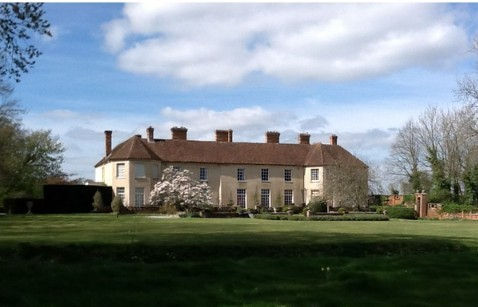
When he died, the Cornwall estate went to his 40-year-old nephew, John Henry Walcot Vowler on condition that Vowler add the Simcoe surname. As had happened at Wolford, the acquired Simcoe name was no talisman. Vowler-Simcoe managed to hang on at Penheale no longer than his cousin’s son Linton-Simcoe at Wolford. Penheale was sold in 1920 (“in a semi-ruinous condition”) to a veteran of the First World War whose soul was in need of as much restoration as his new house.[1] It remains in the hands of his descendants to this day.

The youngest of the Simcoe grandsons, with no hope of an inherited estate, set himself up on a farm called Newcourt in Herefordshire – quite possibly one of the Gwillim properties at Whitchurch. Paul Creed Gwillim Simcoe appears there in the 1861 census, farming 212 acres with the help of a dozen men and boys – and a young woman named Eliza Dance living in his house as a servant. The following year, he and Eliza ran off to Paddington to marry in the same church where his aunt Ann Simcoe had made her own surprising marriage a decade earlier.

Paul Simcoe’s attempt at being a country gentleman, even on a small scale, did not last long. The couple sold Newcourt and by 1871, were living in Wales with four servants, one of whom was Mrs. Simcoe's younger brother. They never had children and died within days of one another at a seaside resort in south Wales. Eliza was just 34 and Paul 40.

If the Simcoe name and land was lost, so too was Elizabeth Simcoe’s religious zeal. Certainly, the Rev. Henry Addington Simcoe’s fourth daughter, Lydia Hannah, did her bit by marrying the Rev. Francis Charles Cole, who presumably shared at least a little of the Simcoe evangelicalism as he was a graduate of Wadham. A second clergyman was grafted onto the family tree when Lydia’s sister, Elizabeth Lethbridge Simcoe, as a 52-year-old widow, married the Rev. John Burton. Burton was the author of (among other things) a published essay entitled Our Protest Against Rome and another that would have equally gladdened Elizabeth Simcoe’s heart: The Church of England Primitive and Apostolic, Pure and Scriptural, Holy and Beloved.[2]
Otherwise, Mrs. Simcoe’s evangelicalism migrated in entirely the wrong direction among her descendants. None of her determinedly evangelical son’s own sons felt called to clerical careers, despite his undoubtedly earnest attempts to convince them. And others took their personal beliefs even further from the source. Granddaughter Emily Simcoe (1845-1916) became an Anglican nun, dedicating her life to converting the people of India. And great-grandson Arthur Levelis Marke (1852-1928) was ordained in the Anglican church, then left in a dramatic conversion to Roman Catholicism in 1884.
The penchant for professional military service also did not last beyond the grandchildren’s generation. As we have seen, John Kennaway Simcoe (1825-1891) had been carted off as little more than a child to follow his namesake great-grandfather’s sails in the Royal Navy. He seems to have been quite content to retire on half-pay after nine years at sea, marry, and establish himself at Wolford as a country gentleman. Grandson Philip served happily for some years in the 6th Cornwall Rifles, perpetuating the volunteer system that his grandfather had championed. In peacetime, however, that service consisted largely of balls and banquets after days of rifle-shooting competitions.
Granddaughter Elizabeth Lethbridge married the battle-hardened General Willoughby Trevelyan; we will consider her full life in a separate post. General Simcoe would not have approved of General Trevelyan. The latter had been in the service of the East India Company and Simcoe had once observed that he considered such service little more than mercenary. It would not be until the wars of the twentieth century that Simcoe descendants would again be drawn into active (and occasionally distinguished) military service.

As I have been unable to find a portrait of Lt. Col. Trevelyan (as his rank would have been at mid-century), I offer a portrait of another officer in the Bengal Cavalry: Colonel Alexander Dewar, circa 1850. The portrait is housed at the National Army Museum.
The personal lives of Elizabeth Simcoe’s grandchildren certainly followed diverse paths. Of the six who married, only three had children – and none of those who had children were sons who could carry on the Simcoe name.
The story of the eldest granddaughter, Anne Eliza (1824-1869) is one of unrelenting sadness. Elizabeth Simcoe lived long enough to see her suitably married to Sedley Bastard Marke, scion of another Cornwall family of landed gentry whose very name is a clue to his social circle (see my biography Mrs. Simcoe for the stories of the ties that bound the groom’s parents to the Simcoe network of friends). Sedley was nearly twenty years older than Anne, enabling the couple to live in immediate comfort, he being in possession of land, copper mines, and houses, including that at No. 17, the Crescent, in Plymouth where they started their family.
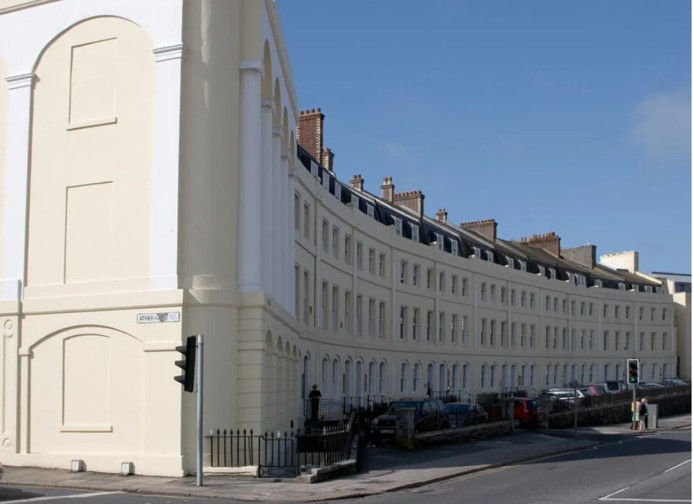
Two sons quickly followed the marriage (Sedley Henry and George Badeley), then daughter Olivia Ann Mary was born and died. Two years later, they had twins: another daughter, christened Olivia Ann Lower (Olive), and Arthur Levelis. Sedley’s widowed mother spent a great deal of time with the family, who clearly needed assistance with all the little ones, although they had the added advantage of six servants, two of whom were nurses for the children.
In 1855, Sedley Marke died, leaving Anne a widow at 31 with four children under the age of seven. Although she now owned considerable land, the mines were struggling and income was a problem. She downsized and moved to a newly-built terrace house in the then-rural Plymouth suburb of Compton Gifford where she made do with just two servants. Her as-yet unmarried younger sister Lydia came to help. The two older boys were eventually sent off to Cheltenham College – not the Eton of earlier Simcoe experience, but highly respectable nonetheless.

The memorial tablet for Sedley Bastard Marke in St. Martin's church, Liskeard, Cornwall. Curiously, it makes no mention of his wife or children. (www.kernowgoth.org)

Unfortunately, it was not long before things unravelled completely. In 1868, Anne took her eldest son, Sedley, to Nice for the winter. Presumably one or both of them was unwell. Neither would return to England. They died at Nice within weeks of one another in 1869.

The following year, second son George married 22-year-old Sophia Maul, daughter of the rector of Rickinghill in Suffolk. Full of high hopes and inheritances, they set off for a honeymoon in Switzerland. There, Sophia was killed in a tragic accident as she fell into a glacier crevasse while hiking on Mont Blanc.

Three years later, George remarried. Emily Archer was the daughter of Devon landed gentry; the couple established themselves at Lew Trenchard near Launceston, leasing the substantial manor house there from the Baring-Gould family.

A daughter (Olivia Alice Simcoe) was born in 1874. Then, while Mrs. Marke was pregnant with their second child, George died at the age of just 26. His son, christened George Badeley Levelis, was born posthumously. Emily soon remarried. Her second husband was an officer in the Royal Navy who took in her two little children and gave them his surname. Their lives did not go well – but that is a story for another time. Suffice it to say that Elizabeth Simcoe managed to produce descendants in two branches of her family who ended up before the criminal courts.
The next granddaughter to marry was Mary Northcote Simcoe (1827-1890) whose husband, John Nicholson Vowler, was the eldest son of an established family with a seat at Parnacott House near Hatherleigh in West Devon. While he waited to inherit, he busied himself with the usual occupations: serving as a magistrate, promoting a railway, chairing dinners at gatherings of agricultural societies, and supporting worthy causes. For many years, he audited the accounts of the Poor Law districts in North Devon. He was a vocal supporter of the Conservative party, providing fodder for mockery from time to time in the local Liberal press.

In between, he and Mary produced seven children, the eldest of whom would inherit Penheale. Curiously, the family moved around a great deal, crossing the border between Cornwall and Devon more than once. But John Vowler died in 1871 before his father, so they were never able to call the pleasant house at Parnacott their own.[3]

The widowed Mrs. Vowler and her children lived for a time with her younger brother at Penheale. Then her whereabouts become unclear, although at the end of her life, she was living with her eldest son just outside London at Addlestone, Surrey. Two of her sons renewed the family role in empire building by becoming managers of tea plantations in Ceylon (now Sri Lanka). A later generation of Vowlers fled Malaysia just ahead of the Japanese, spending the war in South Africa then remaking their lives in what became Pakistan.
The last of Elizabeth Simcoe’s granddaughters to leave a legacy through children was Lydia Hannah (1832-1914). In 1861, she married the Rev. Francis Charles Cole, eldest son of a surgeon from Odiham, Hampshire. The village is east of Basingstoke and not far from Jane Austen’s famous home. The groom’s younger brother (Arthur Raggett Cole) was just then embarking on a distinguished clerical career of his own.
Lydia and Francis would have six children, born between 1862 and 1880, whom they raised in Greywell, Hampshire, a few miles from where Francis had grown up. At one time, they leased the old manor house there, then after 1902, lived in the official vicarage.

And here, the Simcoe story comes full circle, for the manor of Greywell had been purchased in 1786 by none other than Guy Carleton, Lord Dorchester. Sir Guy and Lady Dorchester had preferred to live in the house at Kempshott (where Elizabeth Simcoe and her daughters had visited regularly), but the little Greywell church holds several memorials that commemorate the Dorchester family.
And so, Mrs. Simcoe’s granddaughter worshipped with her husband among Dorchesters past and present. What did they know of the storied connection? Given that Sir Guy ordered his papers destroyed on his death and no records from the Cole family seem to have survived, either, we may never know.

It was one of Lydia and Francis’s sons who renewed the Simcoe connection to Canada through an almost accidental route. Planners for Toronto’s centennial celebrations in 1934 invited Simcoe descendants to attend. Alone among the family, Willoughby Philip Cole (1867-1935) thought it might be fun and brought along his wife and young-adult daughter, much to the delight of imperialists and local historians. Cole’s daughter Dorothy dressed up as Elizabeth Simcoe for one of the events. I explored that story in an essay for the University of Toronto Quarterly.[4]
That leaves granddaughter Elizabeth Lethbridge Simcoe (1828-1907). She married twice but had no children, managing to replicate all the major patterns of her namesake grandmother’s life: military (first husband), religion (second husband), and childlessness (like her Simcoe aunts). Because her life tied together many of the threads of the tapestry woven by her grandmother, I will tell her story in a separate post.
And of course, we must not forget the Rev. Henry Simcoe’s two daughters with his second wife. Their unconventional choices deserve a space all their own.
Thus, as the economic and political systems that had underpinned Elizabeth Simcoe’s life were eroded, her grandchildren needed to find new ways to live. Some held onto a life tied to property and agriculture as long as possible. Some attached themselves to new varieties of religious experience while others abandoned it altogether. It would be left to her great-grandchildren to make the final break with the old world, selling the estates in Cornwall and Devon, and making their way elsewhere in the world as part of the growing cadre of middle-class professionals. While memories of the Rev. Henry Simcoe live on at Launceston, the Simcoes are all but forgotten in the lore of East Devon.
St. Dubricious, the church at Whitchurch, Herefordshire, where Elizabeth Simcoe's Gwillim ancestors worshipped, has one of the few British (non-commercial) acknowledgements of the Simcoe story. These images are from www.herefordshirepast.co.uk


[1] The story of Colonel Norman Colville and his family is told by their descendants on
their website at www.penheale.co.uk.
[2] Our Protest was published at Edinburgh by R. Grant & Son in 1869 and The Church of England at London by Edwards and Hughes in 1849.
[3] Certainly, they did live at Parnacott with the elder Vowlers from time to time. The current owners use the house for a holiday and wedding venue and many of Elizabeth Simcoe’s old family portraits seem to have ended up here. See www.parnacotthouse.co.uk/
[4] University of Toronto Quarterly, 92/4 (November 2023): 661-684. Please do not blame me for the citation system used therein!


Comments